
The short answer: an event’s value as content is decided a week before it happens, not on the day. Walk in with a shot list, booked interviews and a clear crew plan, and you leave with enough material for twelve weeks of publishing. Walk in with one photographer and a vague brief, and you leave with a few photos.
This playbook is a plan you can copy: what to do before the event, on the day, and over the twelve weeks after it.
Why do most events end with a few photos?
Because filming is treated as a logistics line item, not part of the content plan. The crew is booked in the last week, told to “cover the day”, and the company gets busy with guests and rooms.
The result is familiar: lots of shots of the audience from behind, stage footage from one angle, and a highlight video that arrives two weeks later when everyone has moved on. The speakers the company paid to bring in are recorded doing nothing more than their talk.
A conference that took months to prepare becomes a single thank-you post. The cause isn’t budget. It’s the lack of a plan that links what you film to what you’ll publish.
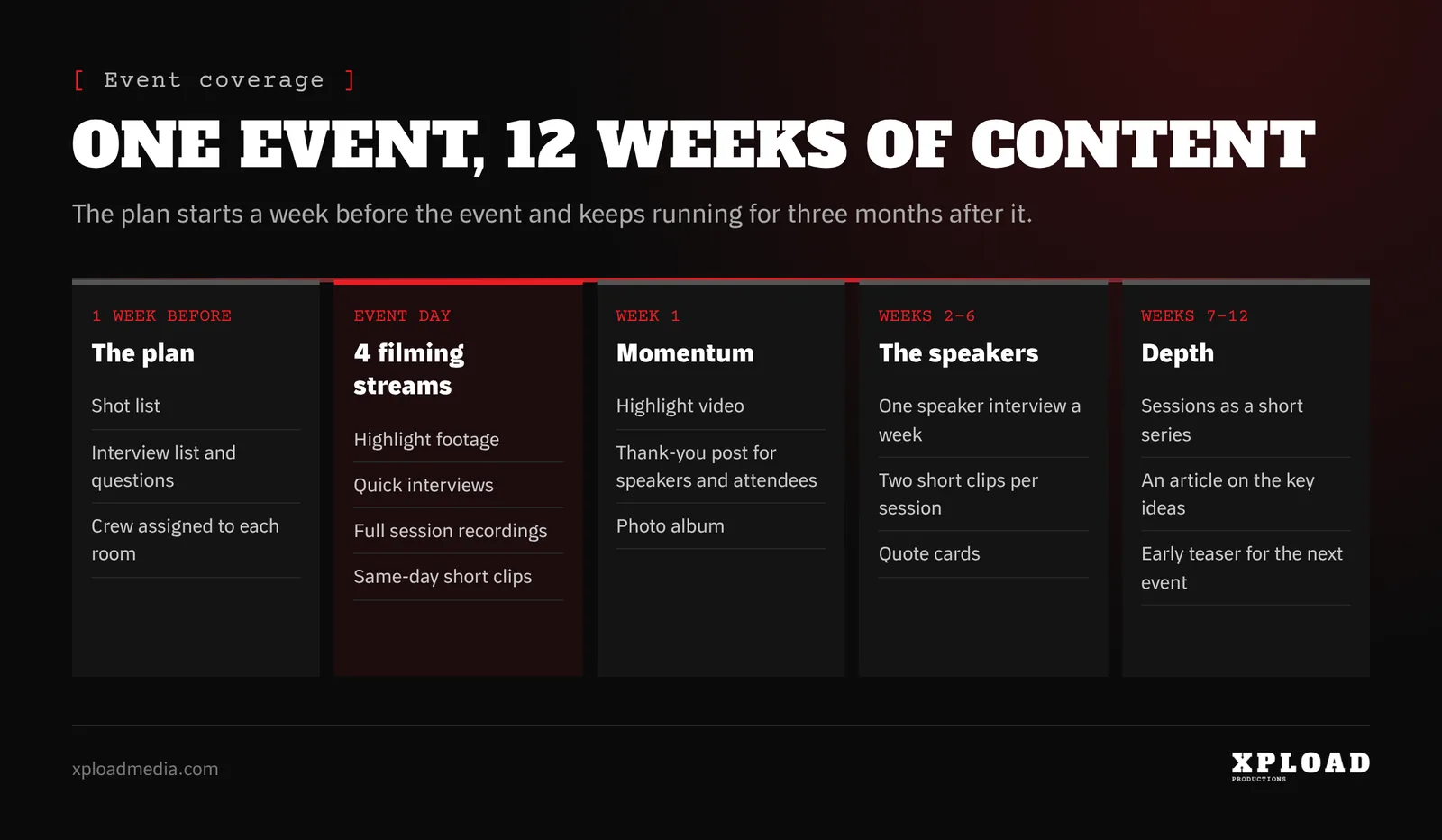
What should you prepare a week before?
Three lists, each answering one question:
1. The shot list: what do we need to see?
Name the moments that must be captured: the keynote opening, the product reveal, the audience reacting to a live demo, your booth at its busiest. Write each one down with its time from the event schedule.
2. The interview list: who do we talk to, and what do we ask?
Pick five to eight people: the main speakers, two or three clients in the audience, and a company leader. Prepare three short questions for each, where every answer can stand alone as a clip. Book a specific time slot with each of them in advance. Grabbing people in the hallway on the day rarely works.
3. The crew plan: who is where?
If the event runs across several rooms, assign each camera operator a responsibility. Dedicate one person to quick short clips that go out the same day.
What should you film on the day?
Four streams running at once, each with a different job:
| Stream | Purpose | Published when? |
|---|---|---|
| Highlight footage | The feel and scale of the event | Week 1 |
| Quick interviews | Speaker and attendee voices | From week 2 |
| Full session recordings | Deep content | From week 7 |
| Same-day short clips | Real-time presence on social | The same day |
The fourth stream is the most overlooked and one of the most effective. Two or three posts during the event make people who didn’t attend feel what they missed, and give attendees something to share while they’re still in the room.
How do you spread the content over 12 weeks?
In three phases, each with its own role:
Week 1: momentum.
Publish the highlight video within 48 hours, with a thank-you post that names the speakers, and the photo album. This is when attendees look for their photos and share the most.
Weeks 2 to 6: the speakers.
One speaker interview a week, with two short clips from their session and quote cards. Every post tags the speaker, so they share it too. Five weeks and five speakers means five chances to reach new networks.
Weeks 7 to 12: depth.
Turn the recorded sessions into a short series, one a week. Write an article on the key ideas from the event. In the final week, tease the next event and ask people to save the date.
In this order, a one-day conference becomes three months of steady presence, without any extra filming.
Who owns what?
Unclear ownership is why most publishing plans stall after week two. Assign roles in writing before the event:
- The company’s marketing lead: approves the plan and interview list, and signs off every post.
- The production team: films, edits and delivers content in batches on schedule.
- The social media manager: publishes, tags speakers and tracks engagement.
- The speakers: receive their clips ready to post, with suggested copy.
Quick checklist
- [ ] Shot list tied to the event schedule
- [ ] Five to eight interviews booked in advance, three questions each
- [ ] One crew member dedicated to same-day clips
- [ ] Highlight video due within 48 hours
- [ ] Twelve-week publishing calendar approved before the event
- [ ] A named owner for each phase
- [ ] A ready message for speakers with their clips
FAQ
How many camera operators does a conference need?
It depends on the number of rooms and tracks. A single-room event usually needs two camera operators and one person for same-day clips. We set the exact number in the planning meeting.
Can we combine coverage with live streaming?
Yes, but streaming needs its own crew and equipment, separate from coverage, so neither has to compromise on quality.
What if the event is internal, for employees only?
The same plan works, with different channels: the internal newsletter and internal platforms instead of LinkedIn. Some clips will still work externally as company-culture content.
Have an event coming up? Request a planning call and we’ll build your shot list and publishing calendar before the day.
Read next: Why B2B Companies Need a Podcast · Event Coverage service · Short-Form Content service