
The short answer: a podcast solves two problems almost every B2B company has. Its content sounds like everyone else’s, and its buyers only buy from companies they already know and trust. A corporate podcast isn’t a fame play. It’s a relationship and sales tool, and its biggest asset isn’t the size of the audience. It’s who sits across the table from you as a guest.
This article covers why podcasts work for B2B specifically, when they don’t, and the three steps to take before you film anything.
Why does B2B content all sound the same?
Because most companies write about themselves the same way: product posts, generic articles on “the importance of digital transformation”, and photos from events. Buyers read five vendors and can’t remember any of them.
The problem runs deeper than style. B2B buyers don’t buy because they saw an ad. They buy because your name was in their head at the moment they needed you, and that moment is rare. Under the “95:5 rule”, published in 2021 by Professor John Dawes of the Ehrenberg-Bass Institute through LinkedIn’s B2B Institute, up to 95% of potential buyers are not in the market at any given time. (>source)
So most people who see your content today won’t buy for months. The real question is how you stay on their mind for those months, with content they actually want to follow.
How does a guest become a client?
A corporate podcast opens a door no other content can: you invite a prospect to speak, instead of asking them to listen.
Say you sell software to retailers. Instead of asking the head of operations at a large chain for a sales meeting, you invite them on an episode about managing inventory through peak season. They say yes because the invitation gives them a stage, not because someone is selling to them.
In an hour of conversation:
- You understand their challenges better than any discovery call would.
- They see your team handle a topic they care about, professionally.
- The episode carries their name, so they share it with their network.
- A relationship starts naturally, built on value you offered first.
Not every guest becomes a client, and that shouldn’t be the stated goal. But a ten-episode season means ten relationships with people you chose carefully, in the market you want to win.
How does a podcast build trust before the first sales call?
It lets buyers “try” your expertise before they pay for it.
When a marketing director spends forty minutes listening to your experts work through a problem they live with every day, something happens that no services page can do. They hear how you think, and they judge its depth for themselves. By the time they’re ready to buy, they’ve already spent hours with you.
Video multiplies the effect, because buyers see faces, not just voices. According to Edison Research’s Infinite Dial 2025, 51% of Americans aged 12+ have watched a podcast, and YouTube is the service most used for podcasts among weekly listeners. (>source)
What do you get from one episode?
One hour-long episode can become weeks of content, if you plan for it from the start.
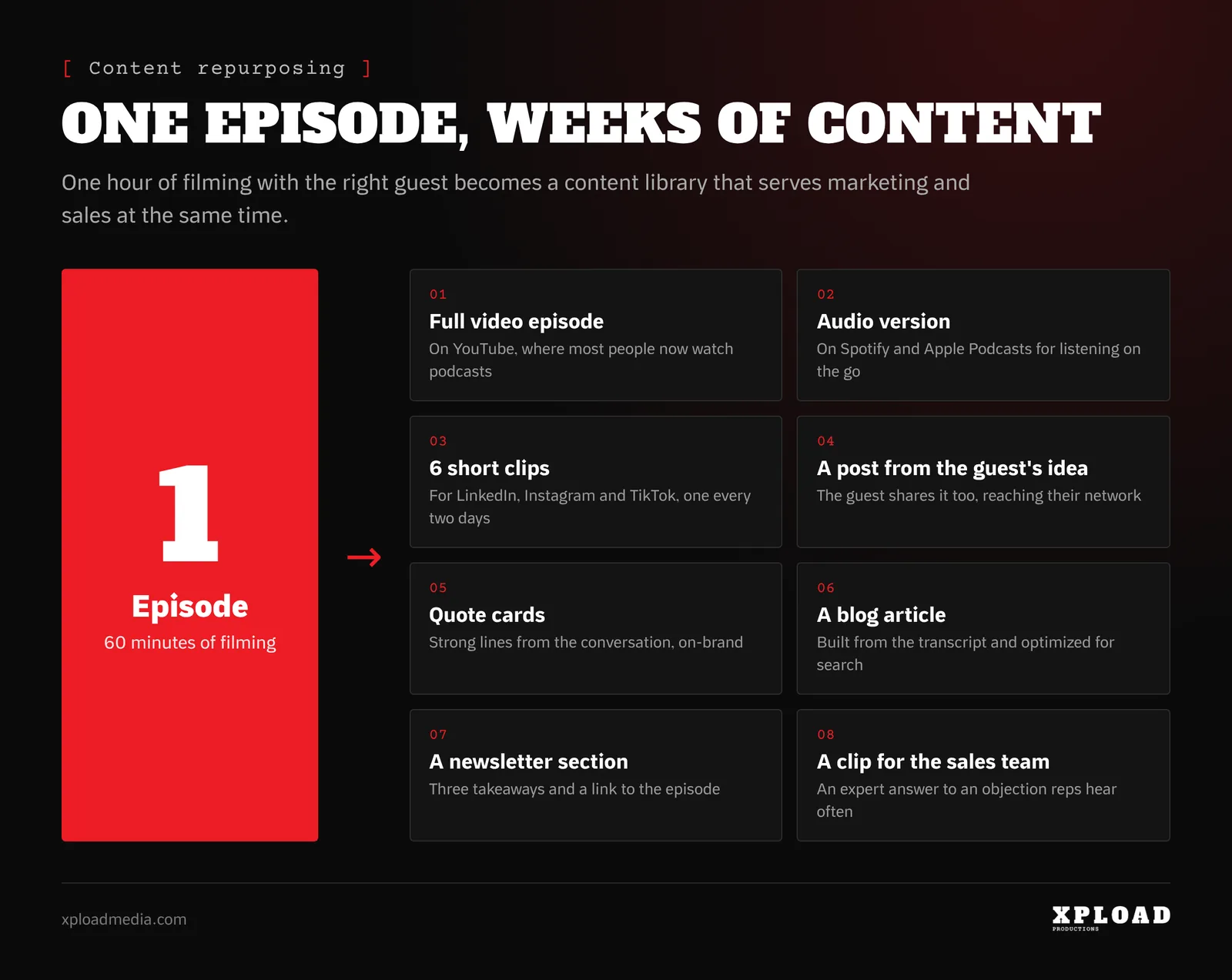
From a single episode you can publish:
- The full video episode on YouTube.
- The audio version on Spotify and Apple Podcasts.
- Six short clips for LinkedIn and Instagram, one every two days.
- A post built on the guest’s key idea, which the guest shares too.
- Quote cards with the strongest lines from the conversation.
- A blog article built from the transcript, working for you in search.
- A newsletter section with three takeaways and a link.
- A clip for the sales team where your expert answers an objection they hear often.
That’s what makes a podcast more efficient than producing each piece of content separately: one shoot, distributed everywhere.
When is a podcast the wrong move?
A podcast isn’t for every company. We’d advise against it if:
- You need sales next month. A podcast builds presence and relationships over months. It isn’t a quick sales campaign.
- Nobody in the company has a real point of view. A show needs someone with expertise, an opinion and the ability to hold a conversation. If you don’t have that person yet, start with other formats.
- You can’t commit to a full season. Three episodes and silence is worse than not starting, because it signals a company that doesn’t finish what it begins.
- Your market is small enough to reach directly. If your prospects are thirty companies you know by name, direct meetings may be faster.
If one of these applies, park the idea and revisit it in six months.
What are the first three steps?
If you decide to go ahead, these three steps come before any decision about cameras or studios:
- Define exactly who the show is for. Not “business leaders”, but “operations heads at mid-sized retailers in Egypt and the Gulf”. The narrower the definition, the easier it is to choose guests and topics.
- List twenty potential guests. If you struggle to name twenty people you’d genuinely want to know, your audience definition probably isn’t sharp enough yet.
- Plan a full season before the first shoot. Eight to ten topics, a guest for each, and a fixed release schedule. That plan is what keeps a show from stalling early.
Then comes production: show identity, set, filming, editing and distribution. That’s the part we take on at XPLOAD, as we did with our own show, El Filter.
FAQ
How much does it cost to produce a company podcast?
It depends on the number of episodes, cameras, filming location and how much distribution you want after each episode. We start with a consultation, then send a detailed proposal based on your scope.
Does the podcast need to be on video?
Not necessarily, but we recommend it in most cases. Video lets you publish on YouTube and gives you material for short clips, which perform best on LinkedIn.
How many episodes before we see results?
We recommend at least an eight-episode season before judging the show. Early results usually show up in guest relationships before they show up in the numbers.
Can someone from outside the company host the show?
They can, but the biggest value comes from an internal host, because the trust the show builds transfers directly to them and to the company.
Thinking about a podcast for your company? Request a consultation and we’ll shape the show concept and first-season plan with you.
Read next: 7 Mistakes That Kill a Corporate Podcast Before Episode 10 · How to Measure Corporate Podcast ROI · Corporate Podcast service