
The short answer: most corporate podcasts don’t stall because of poor quality. They stall because of decisions made before the first shoot: a show about the company instead of its clients, no season plan, a host picked for their title. The good news is that every one of these mistakes can be caught early.
Each mistake below has three parts: how to tell you’re making it, why it’s a problem, and how to fix it.
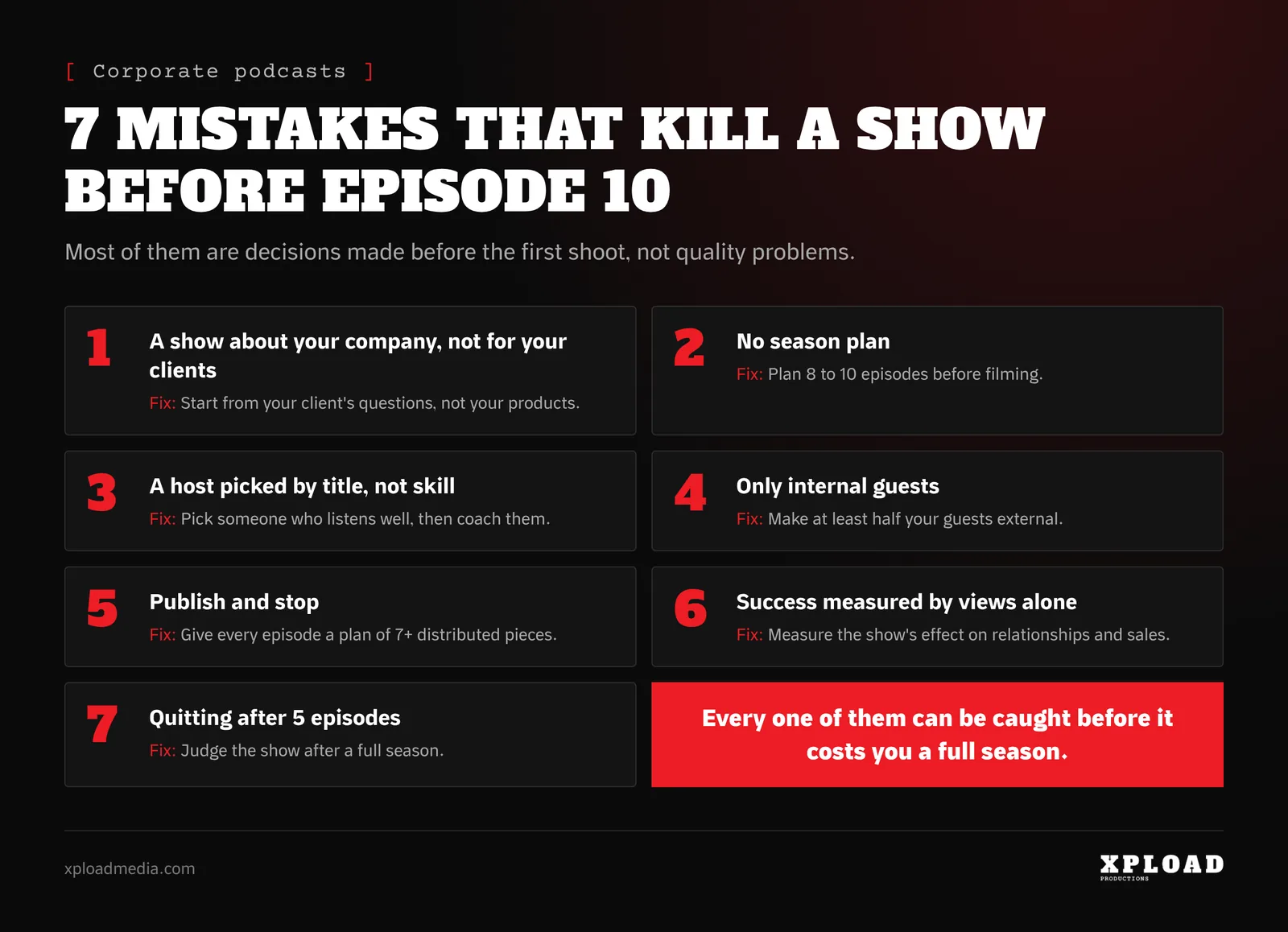
1. Is your show about your company, or for your clients?
How to tell: if episode titles start with your company or product name, or most of the talk is about “our achievements” and “our solutions”, the show is about you.
Why it’s a problem: nobody gives forty minutes to an ad. Clients follow a show because they learn something about their own work, not about yours.
The fix: start from the questions clients ask in sales calls and support tickets. Every recurring question is an episode. Your product comes up naturally when your experts discuss the problem it solves, without being the topic.
2. Do you have a season plan before you start?
How to tell: if the next episode’s topic is decided after the current one goes out, there’s no plan.
Why it’s a problem: a show planned one episode at a time stops at the first busy week. Every delay weakens the audience’s habit of tuning in.
The fix: before filming, write a plan for eight to ten episodes: topic, guest, recording date, release date. Record two or three episodes before launch so you have a buffer if a guest falls through.
3. Did you pick the host for their title or their skill?
How to tell: if the host is the CEO because they’re “the natural face of the company”, and nobody tested whether they can run a conversation, the pick was made by title.
Why it’s a problem: a good host listens more than they talk, and asks the question the audience wants asked. Some leaders are brilliant on stage but interrupt guests or turn every answer into their own story.
The fix: run a short test conversation with two or three candidates and a colleague. Pick the one who makes the guest comfortable talking, then coach them on preparation and follow-up questions. The CEO can be a standout guest in a specific episode instead of the permanent host.
4. Are all your guests from inside the company?
How to tell: if the guest list is department heads in turn, the show has become a filmed internal newsletter.
Why it’s a problem: internal guests say what the audience expects, and they don’t bring new audiences. You also lose the biggest value of a corporate podcast: building relationships with people outside the company.
The fix: make at least half your guests external: clients, industry experts, partners. Pair an internal expert with an external guest instead of having them talk alone.
5. Do you publish the episode and stop there?
How to tell: if the effort ends with uploading to YouTube and writing one post about it, you’re wasting most of the episode’s value.
Why it’s a problem: most people won’t watch a full episode from a company they don’t know yet. They find it through a short clip, a quote or an article they saw first.
The fix: give every episode a distribution plan of at least seven pieces: short clips, quote cards, a post built on the guest’s idea, a blog article, a newsletter section. We break this down in Why B2B Companies Need a Podcast.
6. Are you measuring success by views alone?
How to tell: if the first question after every episode is “how many people watched?”, you’re measuring the wrong thing.
Why it’s a problem: in B2B, your entire target audience might be a few thousand people. An episode watched by three hundred people, twenty of them decision-makers in your industry, beats one watched by twenty thousand who have nothing to do with your business. Judging by views alone pushes you toward broad topics that bring numbers, not clients.
The fix: measure the show on three levels: who’s watching, whether they stay, and what changed in relationships and sales. We cover the full framework in How to Measure Corporate Podcast ROI.
7. Are you quitting after five episodes?
How to tell: if continuing is up for debate after episode five because “the numbers haven’t moved yet”, you’re about to make this mistake.
Why it’s a problem: a show needs time to find its audience, the host needs episodes to find their rhythm, and search engines and platforms need time to understand what the show is about. Quitting early means paying the full cost of starting without reaching the point where results begin.
The fix: agree with leadership up front to judge the show after a full season, and agree on the metrics. If something has to change, change the topics, guests or distribution, not the show’s existence.
How do you avoid all seven at once?
By making the hard decisions before the first shoot, not after. Before you book a studio, make sure you have:
- [ ] A topic list built on client questions, not products
- [ ] A season plan of at least eight episodes
- [ ] A host chosen after a test, with a coaching plan
- [ ] A guest list that’s at least half external
- [ ] A distribution plan for every episode
- [ ] Success metrics agreed with leadership
- [ ] A commitment to finish the season
FAQ
How long should a company podcast episode be?
Usually thirty to fifty minutes. More important than length is that every minute earns its place: a long episode full of pleasantries is weaker than a short, focused one.
Do we need our own studio?
Not necessarily. You can set up a corner of your office with the right set and lighting, or film in an equipped studio. What matters is a consistent location, so the show’s visual identity becomes familiar.
What if a guest cancels at the last minute?
That’s why we recommend recording two or three episodes before launch. The buffer protects your release schedule and gives you time to rebook the guest.
Planning your company’s show? Review your show plan with us before the first shoot, and we’ll help you avoid these mistakes from day one.
Read next: Why B2B Companies Need a Podcast · How to Measure Corporate Podcast ROI · Corporate Podcast service